

Introduction: Why SEO Is a Different Game in California
Try ranking a personal injury firm in Los Angeles sometime. Or a plumber in San Jose. You’ll learn fast that everything you read in generic SEO guides was written by someone who has never competed here.
California is the hardest place in the country to win a Google ranking, and it’s also the place where a ranking is worth the most. Four million small businesses. The largest state economy in America. Customers who research everything, compare everyone, and rarely make it past the first page of results. In a market like that, the gap between page one and page two isn’t a vanity metric. It’s the difference between a full pipeline and a phone that doesn’t ring.
And the ground is shifting under everyone’s feet right now. Google doesn’t just show ten blue links anymore. AI Overviews sit on top of a huge share of searches. AI Mode is becoming the default way a lot of people search. Your future customers are asking ChatGPT and Perplexity for shortlists before they ever open a browser tab. Ranking still matters, but so does something newer: being the business those AI systems actually name. If that sounds like more work, it is. It’s also the biggest opportunity we’ve seen in this industry in a decade, because most of your competitors haven’t figured it out yet.
We wrote this guide for California business owners and marketing leaders who are done guessing. Maybe you’re hiring your first SEO agency. Maybe you’re wondering whether your current one is earning its retainer. Either way, here’s what you’ll walk away with:
- What actually makes SEO in California different, beyond the obvious “it’s competitive”
- How Los Angeles, San Diego, San Francisco, and Sacramento each play differently
- The local, on-page, technical, content, and link building work that moves rankings in 2026
- What AI search changes, and what it doesn’t
- Real pricing numbers, and how to hire an agency without getting burned
Who this is for: Local service businesses, law firms, dentists and medical clinics, home service companies, ecommerce brands, SaaS startups, franchises, enterprise teams. The fundamentals apply to all of them. Where strategy diverges by business type, we say so.
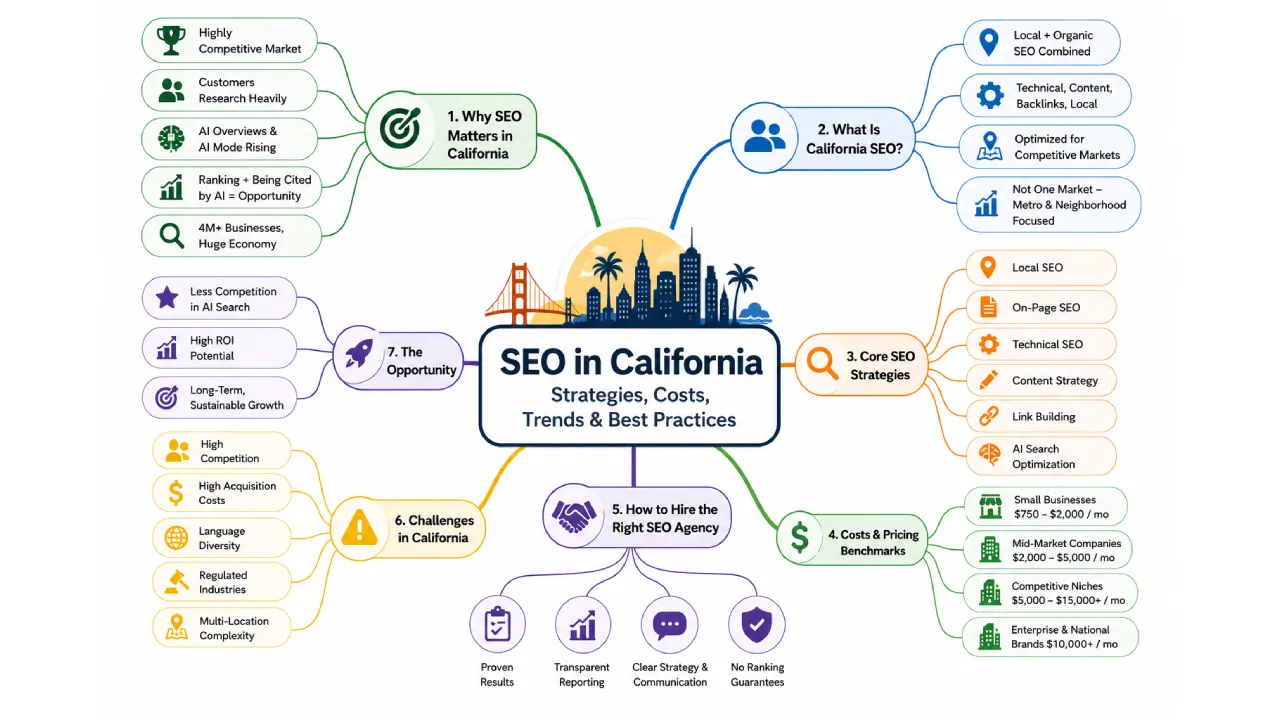
What Is California SEO?
Let’s get the definition out of the way. California SEO means improving how visible your business is in Google search, Google Maps, and AI-powered search for people in California, whether that’s one neighborhood in LA or the whole state. It blends classic search engine optimization (technical health, content, backlinks) with local search work (Google Business Profile, reviews, citations, proximity) tuned for markets that punish sloppiness.
How It Differs from SEO Anywhere Else
Honestly? The tactics aren’t different. The intensity is. In a mid-sized Midwestern city, a clean website, fifty decent backlinks, and a well-kept Google Business Profile can own a niche. Run that same playbook in Los Angeles and you’ll be invisible, because you’re up against firms that have been publishing content and earning links since before Panda, plus Yelp, plus Avvo, plus venture-backed startups with entire in-house growth teams.
There’s also a mistake we see constantly: treating California as one market. It isn’t. Fresno and San Francisco don’t search alike. Neither do Orange County and Oakland. Strategies built around “California + keyword” usually end up mediocre everywhere instead of dominant somewhere. Pick your battles by metro, sometimes by neighborhood.
One more thing. Because the commercial value of California queries is so high, Google loads those results with more ads, bigger map packs, and more AI Overviews. There’s less organic real estate on the page than almost anywhere else. Precision matters more here, not less.
Challenges Specific to This State
- Acquisition costs are brutal on every channel, so leadership expects SEO to show revenue, not ranking screenshots
- Language: Spanish-language search is significant in nearly every metro, and Mandarin, Korean, Vietnamese, and Tagalog matter in specific communities. Most competitors ignore this. That’s your opening.
- Regulated industries (legal, healthcare, finance, cannabis) can’t advertise freely, which makes organic search disproportionately valuable to them
- Multi-location brands and franchises juggle dozens of Google Business Profiles and location pages, usually badly
Who Gets the Most Out of It
Anyone people search for benefits. But the returns get silly in categories where a single customer is worth thousands: personal injury and family law, dentistry, med spas, medical clinics, HVAC and plumbing, roofing, solar, real estate, ecommerce, B2B SaaS, franchises. In those verticals, one new first-page ranking can pay for the entire year’s SEO budget. We’ve watched it happen more times than we can count.
Why California Businesses Need SEO
Your Competitors Didn’t Wait for You
Here’s the uncomfortable framing. In most California verticals, the question isn’t whether to invest in SEO. It’s whether you’re comfortable handing the channel to competitors who already did. The law firms, dental groups, and SaaS companies dominating your searches treat organic traffic as infrastructure, like rent or payroll. Every day they sit in the map pack and you don’t, they intercept buyers who would have called you. And it costs them nothing extra.
How People Here Actually Buy
Californians research. They read reviews, compare three or four providers, and increasingly ask an AI assistant to do the comparing for them. Industry studies have shown for years that a large share of local searches turn into a visit, call, or purchase within days, and that hardly anyone scrolls to page two. Meanwhile, SparkToro and Datos data shows most U.S. Google searches now end without a click to any website at all. Read that again. If the answer appears on the results page itself, in the map pack, in an AI Overview, in a featured answer, then being *on* that results page is the whole game.
The Business Case
Why does organic beat paid over time? Four reasons, and they compound:
- Ads stop the second you stop paying. Rankings, reviews, and authority keep working. An article you publish this year will still be producing leads in year three.
- California ad markets are among the priciest anywhere. Legal and home-service clicks can run $50 to $300 apiece. Organic leads drag your blended acquisition cost down hard over 12 to 24 months.
- Intent. Someone typing “emergency plumber Pasadena” isn’t browsing. They’re hiring today. Organic search catches people at the exact moment of need.
- Defensibility. A competitor can outbid your ad position tonight. They cannot replicate five years of reviews, content, and earned links by next quarter.
Now the honest caveat, because you deserve one: SEO is slow. Credible industry data puts meaningful traffic gains at six to twelve months, with returns compounding from there. Anyone promising page one in 30 days has just told you everything you need to know about their methods. Walk away.
Key California Markets: How the Big Four Compare
Where you compete should change how you compete. Here’s the ground truth on the four flagship metros.
Los Angeles SEO
LA is enormous and it’s fragmented, and the fragmentation is the whole strategy. Santa Monica, Pasadena, Long Beach, the Valley, Downtown: each one behaves like its own local market with its own intent. Competition in legal, med spas, real estate, and home services is as bad as it gets anywhere in the country. So don’t fight the whole city. A med spa that will never crack “botox Los Angeles” can absolutely own “botox Sherman Oaks,” and the patients are just as real. Two more LA-specific notes: proximity weighs heavily in map pack results here, which quietly hands multi-location businesses an advantage, and Spanish-language content is still a genuine differentiator in most service categories because so few competitors bother.
San Diego SEO
San Diego gives you a big consumer market layered with military, biotech, tourism, and a serious hospitality scene. It’s competitive, no question, especially legal, dental, and home services, but noticeably less saturated than LA in most B2B categories. Tourism queries create content opportunities hospitality brands mostly waste, and the North County suburbs, Carlsbad, Encinitas, and neighbors, are still winnable for a well-run local campaign. If you serve tourists, plan for seasonality. And given the daily cross-border flow with Tijuana, bilingual optimization isn’t a nice-to-have here.
San Francisco & Bay Area SEO
The Bay is the most technically sophisticated search market in America, for a simple reason: half the companies here employ their own growth teams. B2B and SaaS competition is extreme. What wins is depth. Original data, engineering-grade content, and real topical authority earn the links and AI citations that thin content never will, and Bay Area buyers can smell thin content from three tabs away. Remember too that the region is polycentric: San Francisco, Oakland, San Jose, and the Peninsula behave as separate local markets, and post-2020 shifts in where people work have rearranged where “near me” demand actually concentrates.
Sacramento SEO
Sacramento is the value play, and we mean that as a compliment. Real search volume, one of the fastest-growing metros in the state, and competition that’s a fraction of what the coast deals with. A surprising number of local businesses here still run on dated websites and half-finished Google Business Profiles. Government-adjacent professional services, healthcare, home services, and real estate can hit page one in months, not years. The suburbs are the sleeper: Roseville, Elk Grove, and Folsom are growing fast, and the businesses building location pages there now will be very hard to displace later.
| Market | Competition Level | Strong Industries | Biggest SEO Opportunity |
|---|---|---|---|
| Los Angeles | Extreme | Legal, Med Spas, Entertainment, Home Services | Neighborhood-level targeting and Spanish-language content |
| San Diego | High | Tourism, Biotech, Dental, Home Services | Target suburban sub-markets and create hospitality-focused content |
| San Francisco Bay Area | Extreme (B2B) | SaaS, Fintech, Professional Services | Build topical authority through original research and AI citation optimization |
| Sacramento | Moderate | Healthcare, Government Services, Real Estate | Gain an early-mover advantage by targeting fast-growing suburban areas |
Local SEO Strategies That Win in California
If you serve customers in a physical area, this section is where your fastest wins live. Google’s own documentation says local results ride on three things: relevance, distance, and prominence. You can’t move your building, so every tactic below works on the other two.
Google Business Profile: Your Second Homepage
Your Google Business Profile probably gets more impressions than your website does. Most owners treat it like a phone book entry anyway. Don’t. Pick the most specific primary category available (this single setting decides which searches you’re even eligible for), fill in every field, post real photos monthly, keep your hours honest, answer the Q&A, and actually use the services and products sections. In a competitive California metro, an active profile beats a stale one even when the businesses behind them are basically identical.
Reviews
Count, velocity, recency, and whether you respond. All of it feeds rankings, and all of it feeds the human decision to call you instead of the next listing. Build the ask into your operations: after the job, at checkout, in the follow-up email. Reply to every review, including the angry ones, especially the angry ones. And never, ever buy reviews. California businesses have eaten Google suspensions and FTC attention for it, and the cleanup is miserable.
NAP Consistency and Citations
Your name, address, and phone number need to match everywhere: website, Google Business Profile, Yelp, Apple Maps, Bing Places, industry directories, the data aggregators. Mismatched citations quietly erode Google’s confidence in your location. Boring work? Extremely. It’s also one of the first things a proper SEO audit should clean up, particularly if you’ve ever moved or rebranded.
Location Pages and Neighborhood SEO
Build one genuinely useful page per city or service area: writing that’s actually about your work there, local proof like projects and reviews and photos, an embedded map, questions people in that area really ask. What doesn’t work is the thing everyone tries first: fifty near-identical pages with the city name swapped out. Google’s helpful content systems were practically built to demote that pattern. In a fragmented metro like LA, go a level deeper. Neighborhood pages, Silver Lake, Brentwood, Los Feliz, often beat broad city pages outright.
Schema, Local Links, and Multi-Location Structure
- Add LocalBusiness structured data to every location page, using the right subtype: Dentist, Attorney, HVACBusiness, and so on
- Earn local links the unglamorous way: chambers of commerce, sponsorships, community organizations, local press, California industry associations
- Multi-location and franchise brands: one Google Business Profile and one indexable location page per location, consistent URL structure (/locations/city), no copy-pasted content between them
- Track map rankings by geography, not just keyword. Being #1 at your front door and #15 three miles away is normal, and you can’t fix what you don’t measure
From our audits: The fastest local wins usually come from three fixes that require zero new content: correcting the Google Business Profile primary category, cleaning up citations left over from an old address, and building review requests into daily operations. Start there before you spend a dollar on anything fancier.
On-Page SEO Best Practices
On-page work is how you tell Google, and now AI systems too, exactly what each page is about and why it deserves to be the answer. None of it is glamorous. All of it compounds.
Title tags still pull real weight. Lead with the keyword and location where it reads naturally, “Personal Injury Lawyer in San Diego | Firm Name,” keep it around 60 characters, and write it to be clicked, not just crawled. Meta descriptions don’t influence rankings directly, but they decide whether your listing gets the click or your competitor’s does, so treat each one like ad copy.
Give every page one clear H1 and structure the headings underneath around the questions people actually ask. This helps human skimmers, and it happens to be exactly how AI systems find passages worth citing. Inside the content itself, answer the query in the first hundred words, then go deep. Match the intent: a service page should sell, a guide should teach, and confusing the two is how you end up with pages that do neither.
A few more items that separate tidy sites from sloppy ones:
- Internal links with descriptive anchor text (“technical SEO audit,” not “click here”), so authority flows and Google understands how your topics connect
- Image SEO: honest alt text, descriptive filenames, modern compressed formats like WebP, lazy loading below the fold
- Entity and semantic signals: mention the people, places, tools, and concepts that belong to your topic. Google matches meaning now, not strings. Sites that cover a subject’s full semantic neighborhood build topical authority; sites that repeat one keyword forty times build nothing.
- UX basics: readable type, scannable formatting, no popup ambushes. If a visitor has to hunt for the answer, so does the algorithm.
E-E-A-T Runs Through All of It
Experience, Expertise, Authoritativeness, Trust. Google’s quality framework, and every core update since 2023 has raised the price of ignoring it. In practice it means real author bylines with credentials, an About page proving actual humans work here, cited sources, your own photos instead of the same stock images everyone licenses, licenses and certifications on display, and the kind of firsthand detail only a practitioner would know to include. For medical, legal, and financial content, where a bad answer can hurt someone, put a qualified reviewer on every page. Not optional anymore.
Technical SEO Essentials
Technical SEO won’t win rankings on its own. What it does is set the ceiling on everything else. Brilliant content on a site Google can’t crawl, render, or trust is a brilliant secret. Any serious engagement should open with a technical SEO audit, and here’s what it needs to cover.
Start with Core Web Vitals, Google’s page experience metrics: LCP for loading, INP for responsiveness, CLS for visual stability. Check the field data in Search Console, not just lab scores. When these fail on mobile, the culprit is nearly always the same pair: bloated JavaScript and unoptimized images. Fix speed beyond the metrics too, because faster sites convert better regardless of what Google thinks. Compress images, defer scripts you don’t need immediately, put a CDN in front of everything.
HTTPS should be a solved problem in 2026, yet expired certificates and mixed-content warnings still show up in audits weekly. And since Google indexes the mobile version of your site under mobile-first indexing, anything that exists only on desktop effectively doesn’t exist.
Then the plumbing:
- XML sitemap: clean, current, indexable canonical URLs only
- Robots.txt: confirm it isn’t blocking sections you need indexed. You’d be amazed how many site launches ship with a leftover disallow-everything rule.
- Canonical URLs on every page, non-negotiable for ecommerce sites where filters and tracking parameters spawn duplicate URLs by the thousand
- Structured data for your organization, locations, services, FAQs, products, and reviews, wherever it’s legitimate. Schema helps search engines and AI systems understand your content confidently enough to reuse it.
- Index coverage and crawl budget for big sites: watch Search Console’s reports, prune thin URLs, kill redirect chains, and make crawlers spend their time on pages that earn money
- Log file analysis on enterprise sites, because server logs show what Googlebot actually crawls, and no other tool will tell you that
- JavaScript rendering if you’re on React, Vue, or Angular: verify critical content and links render server-side or that Google reliably renders them. Bay Area SaaS companies lose more organic traffic to rendering failures than to any competitor. We keep saying this and it keeps being true.
Quarterly checklist: Core Web Vitals in Search Console → index coverage anomalies → sitemap accuracy → broken links and redirect chains → structured data errors → mobile parity → speed tested on a real phone over a real cell connection.
Content Marketing for California Businesses
Content is how you earn rankings, links, and AI citations all at once. But the bar moved, and a lot of businesses haven’t noticed. After the 2025 and 2026 core updates, content that just restates what already ranks is bleeding visibility. What Google and the AI systems reward now goes by the name “information gain”: original data, firsthand experience, a point of view. Things a language model can’t scrape together from the existing web, because they didn’t exist on the web until you published them.
Structure It as Clusters, Not Random Posts
Pick a core topic you want to own, say kitchen remodeling in Orange County. Build one deep pillar page on it. Then surround it with focused articles answering every question a buyer asks along the way: what it costs, how permits work, how long it takes, which materials hold up, what goes wrong. Link them all together. That structure builds topical authority, gives you natural internal linking, and maps neatly onto how AI systems decide whether a site is a credible source on a subject. Random blog posts on whatever seemed interesting that week accomplish none of this. We’ve audited hundreds of sites with three years of blogging and nothing to show for it, and scattered topics are almost always why.
The Mix That Actually Produces Revenue
- Service pages, one per service, with proof, process, pricing guidance, and a clear next step. These are the pages that make money. Most sites underinvest in them and overinvest in blogging.
- Location pages with real local substance (covered in the local SEO section)
- Blog content targeting the questions buyers ask before they’re ready to hire, written or reviewed by someone who does the work
- Case studies with real numbers. Nothing builds E-E-A-T, earns citations, and closes deals like documented results. Painful to produce, worth every hour.
- Video. YouTube is the second-largest search engine, video keeps surfacing in Google results and AI answers, and for a local service business, a practitioner talking on camera is trust evidence no paragraph can match.
About AI-Generated Content
Google’s official line is that quality matters, not how the content was produced. True. Also true: the 2025 and 2026 spam and core updates flattened sites that published unedited AI text at scale. The model that survives is human-led and AI-assisted. Use the tools for research, outlines, first drafts, fine. Then add what only you can: your expertise, your examples, your data, your voice. If a page could have been generated by anyone with the same prompt, it will rank like it.
Link Building Strategies for Competitive Markets
Backlinks still signal authority, and in tight California niches they’re often the tiebreaker between two well-optimized sites. What changed is Google’s tolerance for junk. A handful of relevant links that a real editor chose to publish now beats hundreds of directory placements or bought posts. It isn’t close.
What works, in roughly the order we’d invest:
- Digital PR. Make something journalists actually want: an original survey, a local data study (“what a kitchen remodel costs in every LA neighborhood” pretty much writes its own headlines), expert commentary on news in your field.
- Journalist request platforms, the HARO successors. Answer fast, with substance. California-based experts get quoted in national stories constantly because reporters always need them.
- Guest contributions to publications your buyers genuinely read. Chosen for audience and relevance, never for a promised “DA score.”
- Local links: chamber of commerce, sponsorships, community events, local news. Unglamorous, doubly useful, since they feed local rankings too.
- Legitimate industry directories, bar associations, healthcare directories, licensed-contractor lists. The selective ones. Not the ones that email you.
- Your suppliers and partners. The businesses you already work with are the easiest relevant links you’ll ever get, and almost nobody asks.
- Linkable assets: calculators, tools, glossaries, definitive guides. They attract links passively for years, and resource-page or broken-link outreach gives them a push.
Red flag: An agency selling guaranteed monthly link quantities, or links from a “private network,” is selling you risk with a monthly invoice attached. Google’s spam systems target exactly those patterns, and we’ve cleaned up enough penalty messes to promise you the links were never worth it.
AI Search & Google Updates: The New Visibility Layer
More nonsense has been written about this topic in the past eighteen months than any other in SEO, so let’s be precise about what actually changed.
What’s Actually Happening
AI Overviews now show up on a huge share of Google searches. Ahrefs’ tracking put them near half of monitored queries by early 2026, and they’ve spread well past informational searches into commercial ones. AI Mode, Google’s conversational search, crossed a billion monthly users within a year of launch. Outside Google, buyers ask ChatGPT, Gemini, Perplexity, and Claude for shortlists, especially for bigger purchases, and they arrive at your site already shaped by what those systems said about you.
The click data tells the story. Multiple studies show organic click-through drops sharply when an AI Overview sits above the results. But here’s the part most coverage buries: the sites *cited inside* the answer gain. Research from Seer Interactive and others found brands named in an AI Overview earn meaningfully more clicks than competitors who rank but aren’t cited. And ranking well no longer guarantees a citation; the overlap between top-ten rankings and AI Overview sources has been shrinking all year. So the objective widened. It isn’t rank or be cited. It’s both.
What Google Itself Says
In its 2026 guidance on generative AI search, Google was blunter than usual: optimizing for AI features is still just SEO. No magic files. No exotic schema. No “GEO tricks” sold at a premium. The same foundations that earn rankings, crawlable and indexable pages, genuinely useful content, demonstrated credibility, are what earn AI citations. The one phrase worth memorizing from that guidance is “non-commodity content”: unique perspective, original data, firsthand authority. Stuff a model can’t get anywhere else, because it comes from you.
How to Show Up in AI Answers
- Answer first, elaborate second. Open pages and sections with a clear, quotable answer, then go deep. AI systems extract passages, and answer-first passages get extracted.
- Tighten your entity signals: consistent business info everywhere, a real About page, organization and author schema, the same description of what you do on your site, your Google Business Profile, LinkedIn, and directories.
- Chase brand mentions, not just links. Ahrefs found external mentions among the strongest correlates of AI Overview inclusion, which quietly turned digital PR into an AI visibility strategy.
- Format for extraction: headings phrased as questions, tight paragraphs, lists, tables, FAQs. Good for skimming humans, good for parsing machines. Convenient.
- Build depth on your topics. Recognized authorities get cited across dozens of related queries, not one.
- Measure the new surface. Search Console now reports AI Overview and AI Mode impressions. Track citation share and branded search growth alongside rankings, or you’ll be flying blind on half your visibility.
And keep an eye on the core updates, because they all point one direction. December 2025, March 2026, May 2026: each one shifted visibility away from aggregators and summarizers toward original sources, brands, and data-rich destinations. The strategic takeaway for California businesses is simple and a little uncomfortable. Authority stopped being optional.
SEO Costs in California: What to Actually Expect
Nobody publishes honest pricing, so buyers walk into sales calls blind. Here’s the picture, built from published 2026 industry data, Ahrefs’ survey of 439 SEO professionals, Clutch’s agency benchmarks, several agency pricing studies, and adjusted for California, where talent, competition, and client expectations all run hot.
| Engagement Type | Typical U.S. Range (2026) | Typical California Range | Best For |
|---|---|---|---|
| Local SEO Retainer | $1,000-$3,000/mo | $1,500-$4,000/mo | Single-location service businesses |
| Small Business SEO | $1,500-$5,000/mo | $2,500-$6,000/mo | Growing businesses in competitive metros |
| Mid-Market / Ecommerce | $5,000-$10,000/mo | $5,000-$12,000/mo | Multi-location businesses, ecommerce stores, and regional brands |
| Enterprise SEO | $10,000-$50,000+/mo | $10,000-$50,000+/mo | Large websites and highly competitive national industries |
| Hourly Consulting | $100-$300/hr | $150-$300+/hr | In-house marketing teams needing SEO strategy and guidance |
| One-Time Audit / Project | $5,000-$30,000 | $5,000-$30,000+ | SEO audits, website migrations, and penalty recovery projects |
For calibration: Ahrefs’ 2026 survey has agencies averaging about $99 an hour and consultants around $171, and Clutch pegs the average monthly engagement near $3,200. In our experience, a single-location California service business in a competitive metro lands somewhere between $2,000 and $4,000 a month for a program that actually moves. Below that, the math gets hard.
What Moves the Price
- How competitive your industry is. Legal and medical cost more than niche B2B because the fight is harder, not because agencies are greedy. Well, not only.
- Geographic scope: one suburb, one metro, statewide, national
- Your starting point: existing authority, accumulated technical debt, how much content already exists
- Content volume, and whether it needs expert review (medical, legal, financial content should)
- AI search scope. Plenty of agencies now line-item AI visibility work separately, and demand for it is climbing.
Run the math on cheap SEO: At realistic U.S. rates, a $500 monthly retainer buys four, maybe five hours of work. That can’t cover strategy, content, technical fixes, links, and reporting. So it doesn’t. Ultra-cheap packages are automated, offshored, or actively harmful, and in a competitive California market they don’t move anything except money out of your account.
Thinking About ROI
Do this before you sign anything: average customer value, times realistic monthly leads from the rankings you’re targeting, times your close rate, against twelve months of fees. A San Diego dental practice where a new patient is worth two thousand dollars in first-year value needs roughly two extra patients a month to justify a $3,000 retainer. Two. That’s the whole reason expensive-but-effective beats cheap-but-inert every single time.
How to Choose the Right California SEO Agency
There’s no license for this work and the barrier to entry is a laptop, so the diligence falls on you. Here’s how experienced buyers sort real operators from retainer collectors.
Ask These Before You Sign
- “Walk me through a client in my industry. Where they started, what you did, what happened to their revenue.” Rankings alone don’t count.
- “What exactly happens in the first 90 days? What does month six look like?”
- “Who works on my account day to day, and how many other accounts do they carry?” A strategist with 30 clients is an account manager with a nicer title.
- “How do you build links? Show me links you’ve earned.” Vague answers here are disqualifying.
- “What are you doing about AI Overviews and AI assistants, and how will you measure it?” Blank stares are your answer.
- “What does reporting look like, and which numbers count as success?”
- “If we part ways, what happens to my site, my content, my analytics access?” If anything isn’t yours, run.
Green Flags vs. Red Flags
| Green Flags | Red Flags |
|---|---|
| Specific, verifiable case studies with measurable business outcomes | Guaranteed rankings or promises of “page one in 30 days” |
| Clear deliverables, transparent pricing, and flexible agreements | Vague scopes of work and long-term contracts with high exit penalties |
| You retain ownership of your website, content, and all marketing accounts | The agency owns your website or Google Business Profile while you’re a client |
| Performance reports focused on leads, calls, conversions, and revenue | Reports filled with rankings for low-value or irrelevant keywords |
| Realistic timelines (6–12 months) with honest discussions about risks | Claims of a “special relationship with Google” or secret ranking methods |
| Asks detailed questions about your business goals, margins, and capacity | Offers the exact same SEO package to every business regardless of industry |
One more filter, and it’s become our favorite. Search the agency’s own name. Ask an AI assistant about them. An SEO expert who can’t make their own firm visible is making a claim their results contradict.
Common SEO Mistakes California Businesses Make
We see the same failures on repeat. If any of these sound familiar, fix them before you spend another dollar on anything new.
- Publishing content onto a site with unresolved technical problems, which is pouring water into a cracked bucket
- Keyword stuffing and doorway pages. Google’s spam systems catch these reliably now, and the penalty hits the whole domain, not just the offending pages.
- Fifty location pages with the city name swapped. Ranks nowhere, helps no one, wastes crawl budget.
- Orphaned content: publishing good pages, then leaving them three clicks from anywhere with no internal links pointing in
- A half-finished Google Business Profile in a market where the map pack eats most local clicks
- Bought backlinks. Short-term wiggle, long-term liability, expensive cleanup.
- Ignoring mobile UX when most local searches happen on a phone in a parking lot
- Thin pages that exist to hold a keyword rather than answer a question
- Publishing sporadically on random topics, then concluding “content doesn’t work.” It works. Strategy-free content doesn’t.
- Quitting at month four, which is usually right before the compounding kicks in. SEO punishes inconsistency more brutally than any mistake on this list.
California SEO Trends for 2026 and Beyond
Where this is heading, based on what we’re seeing in the data and in client accounts right now:
- AI search becomes the default surface. With AI Mode’s adoption curve and Overviews spreading across query types, citation share now sits next to rankings as a primary KPI. Plan for both or fall behind on one.
- Entities and brands beat keywords. Google and the LLMs reward businesses they recognize and can describe consistently. Branded search growth, mentions across the web, and a coherent identity are now ranking assets, not marketing fluff.
- Experience is the moat. Firsthand expertise, original data, real photos, named practitioners. That’s what separates content that gets cited from content that gets summarized away without credit.
- Zero-click reality forces new measurement. When most searches end without a click, smart teams track AI impressions, branded demand, calls, and direction requests, not sessions alone.
- Video and multimodal search keep growing. Younger Californians start on YouTube, TikTok, or Maps, and Google’s search box now accepts images and video. Businesses with visual proof of their work win.
- Queries get longer and more conversational, spoken and typed. Content built around natural questions matches how people actually ask.
- Local AI results arrive. Assistants increasingly answer “best X near me” directly from reviews, Business Profile data, and web reputation, which makes those local trust signals more valuable, not less.
- Trust consolidates. Every recent core update moved visibility from aggregators toward original, authoritative destinations. The position to hold through 2030: be a source, not a summary.
Frequently Asked Questions
How much does SEO cost in California?
Most California small businesses spend $1,500 to $6,000 a month depending on the market. Single-location local campaigns start around $1,500 to $2,500; competitive-metro or multi-location programs run $3,000 to $10,000 and up. Hourly consulting sits at $150 to $300. Anything dramatically cheaper can’t fund real work, and usually doesn’t.
How long until SEO works?
Early movement in two to four months, meaningful traffic and lead growth around months six to nine, full compounding over twelve to eighteen. Sacramento moves faster than Los Angeles because the competition is thinner. Anyone promising much faster is either lying or cutting corners you’ll pay for later.
Is SEO still worth it now that Google answers with AI?
Yes, and arguably more than before, because the goal widened rather than disappeared. AI Overviews cut clicks on some queries, but the sources cited inside those answers gain visibility and trust, and Google’s own guidance says strong SEO is what earns the citation. Stop investing and you vanish from both surfaces at once.
What’s the difference between local SEO and regular SEO?
Local SEO targets geographically constrained searches: the map pack, your Google Business Profile, reviews, citations, location pages. Traditional SEO targets organic rankings wherever the searcher sits. Most California service businesses need both, weighted toward local, because that’s where their buyers are.
Do I need a California-based agency?
Skill beats zip code. That said, California market knowledge is a real edge: neighborhood-level competition, multilingual audiences, how regulated verticals behave here. The thing you should never bend on is verifiable results in your industry and your kind of market.
Can I just do SEO myself?
In a low-competition niche, a diligent owner can cover the basics: Business Profile, reviews, foundational content. In a competitive California metro you’re up against funded, full-time teams, and most owners create more value spending those hours running the business. Know which situation you’re in before deciding.
Why does everyone keep talking about Google Business Profile?
Because for local searches it often gets more visibility than your website. It powers Google Maps and the local pack. Category accuracy, completeness, photos, posts, and review activity all decide how often you show up, and it’s free, which makes neglecting it genuinely strange.
What are AI Overviews and how do I get into them?
They’re the AI-generated summaries at the top of many Google results, with citations back to source sites. You earn a citation the same way you earn a ranking: crawlable pages, answer-first structure, demonstrated expertise, strong entity signals, and a brand that gets mentioned around the web.
Does AI-generated content hurt SEO?
Unedited, mass-produced AI content is precisely what the 2025 and 2026 spam and core updates demoted, so yes, that version hurts. AI-assisted content, drafted with tools, then shaped by real expertise and editing, does fine. The test is brutal and fair: does the page contain anything the reader couldn’t get elsewhere?
How do I measure SEO success beyond rankings?
Qualified organic leads (calls, forms, direction requests), organic revenue, branded search growth, AI Overview and AI Mode impressions in Search Console, map pack visibility across your whole service area, and cost per acquisition next to your paid channels. Rankings are an input. Those are outcomes.
What should an SEO audit include?
Technical health (crawling, indexing, Core Web Vitals, mobile), on-page optimization, content quality and gaps, backlink profile with toxic-link risk, local presence (Business Profile, citations, reviews), competitor benchmarking, and a prioritized roadmap. Expect $5,000 to $10,000 for a credible comprehensive audit from an established firm.
Is SEO different for ecommerce, SaaS, or professional services?
Same foundations, very different emphasis. Ecommerce lives and dies on technical SEO, product schema, and category pages. SaaS wins on topical authority and bottom-funnel comparison content. Law and medicine run on E-E-A-T, reviews, and local dominance. Which is exactly why industry experience belongs on your hiring checklist.
What happens if I stop?
Nothing at first. That’s the trap. Rankings decay slowly while competitors keep publishing and earning links, technical debt piles up, content goes stale. In a competitive California niche, six dormant months can surrender positions that took two years to win, and winning them back costs more than keeping them would have.
Conclusion: The Businesses That Win California Search
California search is competitive because it’s valuable. There’s no way around that, and honestly, you wouldn’t want one, because the difficulty is what makes the position worth holding once you have it. Every trend in this guide, AI Overviews, entity-driven rankings, the flight toward authoritative sources, points the same way: Google and the AI systems keep getting better at rewarding businesses that are genuinely good at what they do and can prove it publicly. Terrible news for shortcut sellers. Very good news for real operators willing to invest consistently.
If you remember six things: Treat SEO as infrastructure, not a campaign. Win locally first: Business Profile, reviews, location relevance. Publish only what you alone could publish. Fix the technical foundation before scaling anything on top of it. Optimize for citations and rankings together. And judge agencies, and SEO itself, by leads and revenue, never by rankings alone.
If you’re ready to compete seriously in California search, that’s exactly what we do at DexDel. Our California SEO strategies are built on the principles in this guide, because this guide is how we actually work: honest technical foundations, content with real information gain, local dominance where you operate, and visibility across both Google and AI search. Every engagement starts with a comprehensive SEO audit, so you see precisely where you stand and what winning will take before you commit to a thing.
Request your California SEO audit from DexDel today, and find out what your market looks like when you’re the business everyone else is chasing.